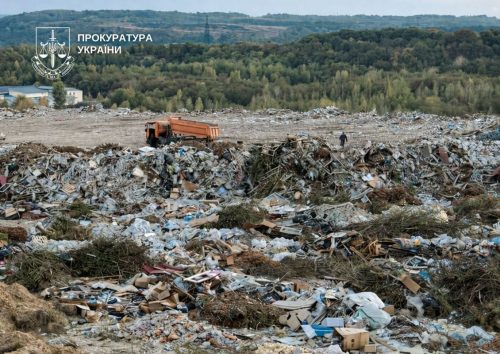
The essence of the environmental tax is simple: the polluter must compensate for the damage caused to the environment with money. In just 9 months of 2025, Ukrainian businesses paid UAH 4.2 billion for their environmental impact. However, this resource must be used effectively on the ground.
EcoPolitic analyzed what activities communities should use the environmental tax for and whether this is true.
"Conditional" environmental protection measures
The environmental tax was introduced in Ukraine in 2011. In theory, all funds should be used only for environmental protection measures. However, cases when funds end up outside the targeted expenditure items or under "conditionally" environmental ones are not isolated, but systemic.
55% of the environmental tax, except for the tax on radioactive waste and carbon dioxide emissions, is directed to the regions. The funds are distributed to special environmental protection funds of regions, cities and communities. In addition, these funds are formed from a portion of the penalties for environmental damage, as well as from third-party targeted and voluntary contributions. We are talking about billions of hryvnias annually.
All of these funds are earmarked, and the Cabinet of Ministers' resolution of 1996 defines what these purposes can be. It is this document that communities refer to when formulating their list of environmental protection measures. Among the areas of activity that are really important for environmental protection, the resolution also includes those that can hardly be called purely environmental.
This was pointed out back in 2019 by a group of scientists in the publication “Effective Economy.” After analyzing the effectiveness of the use of eco-funds, they noted that environmental tax revenues significantly exceed the costs of targeted environmental protection measures.
“In addition, through manipulation of legislation, programs are being financed that are only conditionally environmental or not environmental at all,” the scientific study says.
Examples from communities
The situation has not changed. Taking advantage of the abstract nature of the legislation, local councils use environmental tax revenues to cover the costs of engineering communications and public amenities.
For example, in the city of Vinnytsia, special fund revenues are used to build and reconstruct sewerage networks. To this end, money is transferred to the Department of Public Utilities and Improvement. Last year, this accounted for 65% of the city's Environmental Protection Fund expenditures. The construction and expansion of sewerage networks is also on the list of measures for smaller councils, such as the Novooleksandrivska territorial community in the Dnipropetrovsk region.
“Environmental friendliness” is directly associated with crop production, so the Kropyvnytskyi City Council has included the greening of educational institutions and even the elimination of the consequences of natural disasters, such as windbreaks and snowbreaks, in its Program of Environmental Protection Measures. In the Lutsk city community, the Environmental Protection Fund financed the greening of settlements and the mowing of weeds in the coastal strip of rivers.
The environmental component is present in many types of activities. If desired, it can be “built into” measures that essentially relate to the sphere of urban management and improvement. This gives communities the opportunity to use targeted environmental funds for purposes other than those for which they were intended. And all these measures in no way reduce the negative impact for which the polluter pays.
EcoPolitic has previously written about the ranking of regions paying environmental taxes.