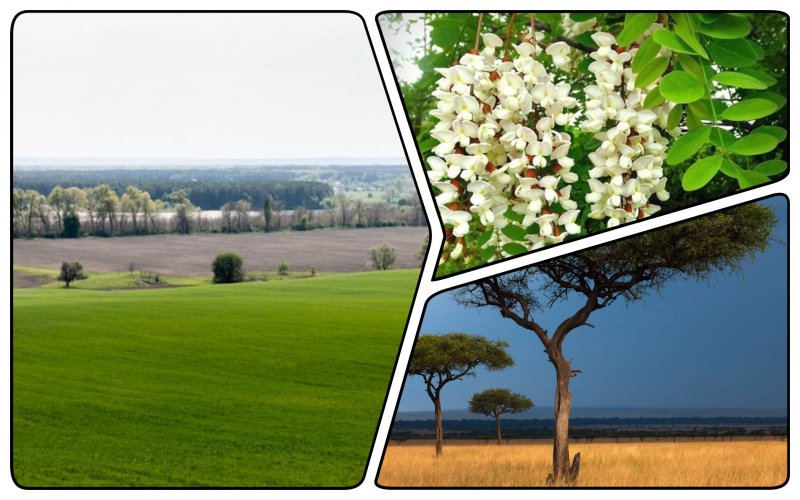
The head of the Society of Foresters of Ukraine, Yuriy Marchuk, said that white acacia, black walnut, red oak, and triscotyledon should be excluded from the list of invasive tree species that are prohibited to be planted in forests and field protection strips.
He told about this in an interview with Ukrinform. According to Marchuk, although these trees are invasive (alien), they are of great importance for the restoration of steppe and forest-steppe zones.
He said that the conditions in the steppe zone are quite specific and local tree species such as pedunculated oak, Scots pine, etc. often die. Therefore, during the active creation of field protection strips after the Second World War, introduced trees began to be actively planted. They helped to protect soils from wind erosion and rivers from shallowing.
Marchuk explained that these trees have a powerful root system and were able to stop the soil from sliding in gullies, ravines and on slopes. They can also provide the need for wood, and acacia is also a honey crop. Such properties of trees will be especially relevant during the restoration of the de-occupied territories of the south and east of Ukraine.
He added that during the round tables to create a list of invasive tree species prohibited for planting, biologists and botanists from the National Academy of Sciences gave their conclusions without taking into account the opinion of the Society of Foresters.
"The opinion of environmental organizations, which were prepared only theoretically, influenced the situation we have politically," said Marchuk.
He said that the Society sent a letter to the Ministry of Environmental Protection and Natural Resources with a proposal to create a list of invasive species within each geographic zone.
"Trees should grow where they play an important role, work for the environment and for the harvest, and where other species simply won't exist," Marchuk said.
According to him, grass used to grow in the Steppe, but active agriculture has changed it. In addition, foreign species have become an integral part of Ukraine, so even on the coat of arms of Kyiv there is an inflorescence of a common bitter chestnut, which was once brought from the Balkans.
Earlier, EcoPolitic wrote, that in May, the Ministry of Environmental Protection and Natural Resources approved a list of alien, i.e. invasive, species of trees that are prohibited from being planted for the creation and restoration of forests and field protection strips.
Previously, EcoPolitic analyzed the danger posed by invasive species.