Researchers from the University of Houston (UH) and the Mexican Intercultural University of Indigen de Michoacan (UIIM) have developed soot technology that increases the efficiency of converting solar energy into heat more than fullerenes, graphene or nanotubes.
They used burnt wood soot to make a pasty coating, informs University of Houston.
"Our raw material is environmentally friendly, although it is currently considered a pollutant. However, it is ideal for reducing carbon footprint and can contribute to a real transition to zero energy," said Francisco Robles-Hernandez, UH's professor of mechanical engineering.
Soot, including black carbon, is a major factor in the melting of polar ice, and its absorption is of great interest to climate and energy researchers.
"Soot production does not consume energy because it is a by-product in large quantities, and its reuse can only reduce the carbon footprint. The cost is almost zero, making it cost-effective and ideal for converting solar energy into heat," said Robles. -Hernandez.
He also noted that the project has the potential for commercialization.
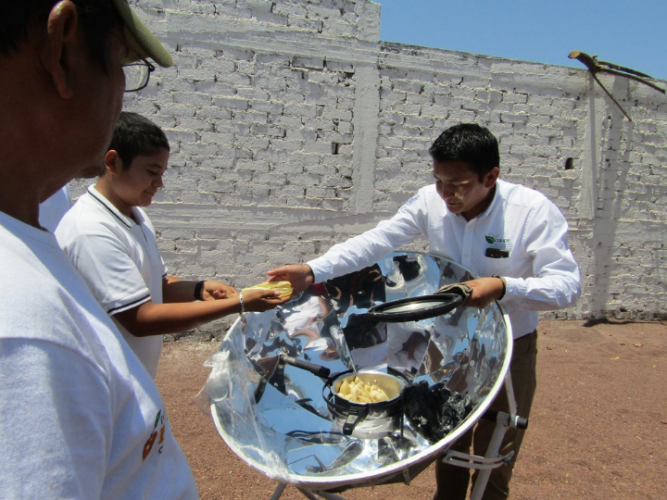
As part of the project, the team has developed solar furnaces that can be heated to 400 degrees Fahrenheit (204 ℃). The cost of producing the furnace is $ 150, and the new coating that provides it with power costs only about $ 1 per square meter.
This technology can be used in large heaters or boilers to dry a large number of industrial products. After all, drying is one of the most energy-intensive and costly industrial processes. Researchers say soot-based heat-absorbing materials can also be used for solar columns, heating water pipes or homes, water purifiers and other technologies.
"The next step for this project is the mass production of solar-to-heat converters for the food industry. Ultimately, the motivation for this project is to benefit the environment by using carbon waste or by-products for domestic and industrial processes," added Luis Bernardo. Lopez-Sosa is Professor of Engineering for Energy Sustainability at UIIM.
We will remind, invented in Canada eco-concrete from waste, which is stronger than usual.
As reported EcoPoliticа before, British company developed cheap carbon capture technology algae.