The solar energy sector had been developing rapidly in Ukraine even before the full-scale war. However, following the start of the invasion in 2022, the country lost over 30 per cent of its solar capacity. But the instability in the energy sector caused by shelling has triggered a new boom in solar power plants and a shift in the very philosophy behind their installation. This has already meant that Ukraine has not only made up for the losses suffered at the start of the war, but has also exceeded its pre-war capacity.
The publication ‘Ekonomichna Pravda’ reports on this in its article.
The situation up to 2022
As of 2015, the total capacity of solar power plants installed in Ukraine barely reached 1 GW. However, by 2019 this figure had risen to almost 6 GW, and by early 2022, Ukrainian solar power plants had a combined capacity of around 8 GW.
The key driver for the sector’s development at that time was the ‘green’ tariff – state guarantees to purchase clean energy at a higher price.
Consequently, during that period, solar power stations were primarily an investment. Major investors built large-scale solar power stations, selecting regions with the best insolation conditions.
The case of the Kyiv region
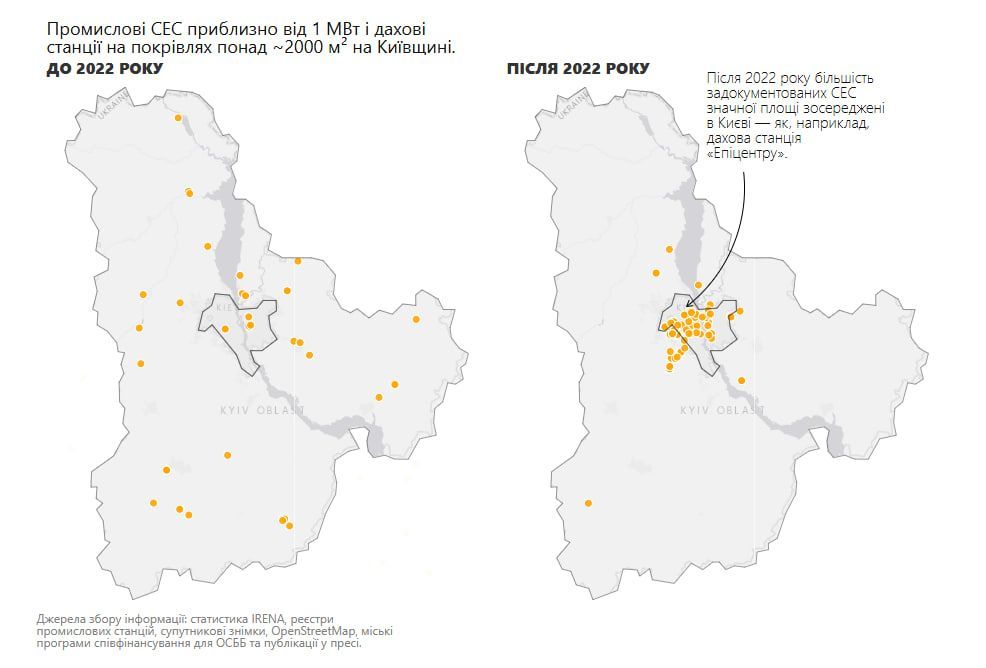
By 2022, the region’s solar energy sector comprised several large solar power stations. There were 49 such facilities, the vast majority of which were scattered across the region. After 2022, the number had risen to several hundred solar power stations, but their geographical distribution had changed. During the full-scale war, they began to be actively installed on the roofs of shopping centres, residential buildings and warehouses right in the city. The number of domestic solar power stations doubled to 87,000.
Instead of the ‘green’ tariff, energy independence became the main driver behind the development of solar power stations. With the Russians systematically destroying the energy infrastructure, consumers can no longer rely on centralised supply.
Source: "Ekonomichna Pravda"
A decline and a sharp post-war surge
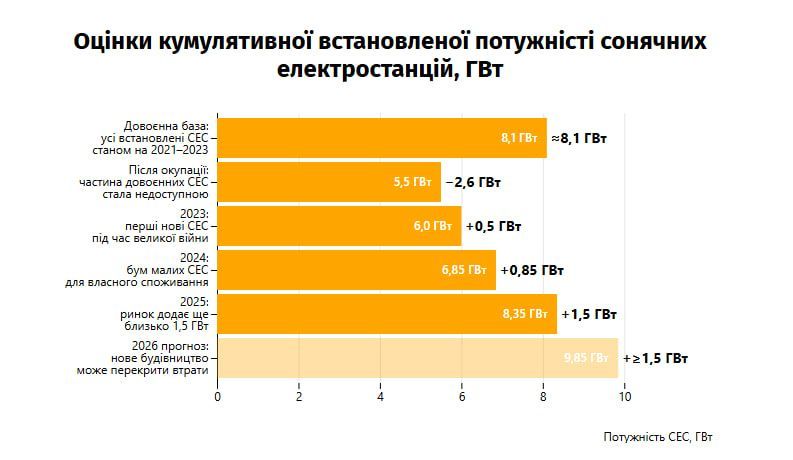
Due to the full-scale invasion, solar generation capacity in Ukraine fell by 2.6 GW. These figures were reported by the International Renewable Energy Agency (IRENA).
However, on-site solar power stations subsequently became almost mandatory for new commercial construction projects. According to the Solar Energy Association of Ukraine (ASEU), up to 90 per cent of such projects have their own solar panel arrays with a capacity of over 1 MW.
Overall, it is extremely difficult to provide precise figures for the growth in solar generation. The key reason for this is that much of it is installed for self-consumption, outside the ‘green’ tariff scheme. Consequently, the ASEU analyses customs data, information on licences issued by the NEURC, and bank loans.
In 2024, the increase in solar generation stood at around 800–850 MW according to the ASEU and 300–900 MW according to IRENA. Throughout 2025, solar power plants with a total capacity of 1.5 GW were additionally built in Ukraine. A similar amount is expected this year.
As of early 2026, the total capacity of Ukraine’s solar power sector was estimated at approximately 8.35 GW. Overall, between 2022 and 2026, Ukraine will add around 4 GW of solar generation capacity.
Source: "Ekonomichna Pravda"
EcoPolitic reported that in Ukraine, the share of “green” energy in total electricity generation in 2025 amounted to 11%.