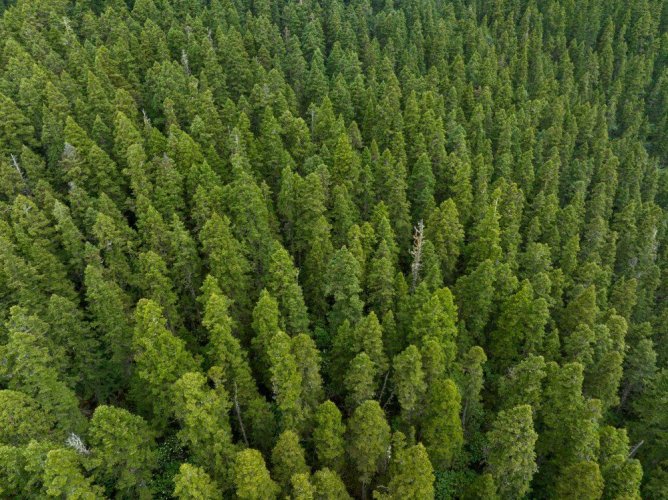
Ukraine is trying to improve forest management, but many draft decisions carry the risk of illegal logging and biodiversity violations. According to experts, the draft order of the State Forestry Agency, which is supposed to define the "symptoms" of a forest in need of reform, is also flawed.
As noted by WWF-Ukraine, the version proposed by the State Forestry Agency will enshrine norms that are dangerous for natural ecosystems.
The draft order of the Ministry of Economy "On the Approval of Unified Lists and Diagnostic Signs of Forest Types of Native (Target) Tree Stands" is supposed to harmonize the Ukrainian classification of forest types with the European one. However, according to experts, it does not fulfill this task.
“The current draft order focuses primarily on economic value and does not provide sufficient mechanisms to prevent the erroneous designation of valuable forests for logging. This poses risks to biodiversity, including species listed in the Red Data Book,” emphasized Mykhailo Bohomaz, Head of the “Forests” Program at WWF-Ukraine.
Valuable Forests at Risk
It is evident that the document prioritizes economic needs rather than rational forest management. Experts point out that the order defines the types of forest stands too formally. As a result, valuable forests that do not require any restructuring will be at risk of logging.
WWF emphasizes that the document must explicitly exclude natural, old-growth, and floodplain forests from the list of forests where restructuring cuts may be carried out. The organization asserts that such interventions should only be permitted in artificial and derivative forests.
Ignoring the fate of rare species
The draft document pays insufficient attention to the issue of preserving red-listed species. Experts insist that work in sensitive areas is only possible on the basis of scientific justification and professional expertise. And in any case, such intervention should be minimal.
Vague terminology and inconsistency with international standards
The terms in the order are defined formally. According to WWF-Ukraine, the concepts of "target tree stands" and "derived tree stands" are insufficient to describe the diversity of Ukraine's forests. This makes the classification too simplistic, which carries the risk of erroneous logging.
At the same time, the document is inconsistent with European forest management standards and does not provide for scientific control.
WWF recommends expanding the list of forest stand types to describe the full spectrum of possible forests and to clearly define these in the document. Scientists must be involved in this process, and terminology should be aligned with international classifications (EUNIS, Natura 2000).
The organization submitted its suggestions to the State Forest Resources Agency to improve the draft. Some of these were taken into account, but controversial provisions remain in various regulations.
“Key environmental restrictions and conditions for implementing restructuring cuts remain scattered among different legal acts. This creates risks for the practical application of decisions on the ground, which continue to require professional discussion,” writes WWF-Ukraine.
Documents related to forest management are systematically criticized by environmental activists. EcoPolitic reported that the draft resolution “On Amendments to Certain Resolutions of the Cabinet of Ministers of Ukraine Regarding the Regulation of Timber Harvesting Issues” in fact reintroduces clear-cutting.
At the same time, the government may cancel the Environmental Impact Assessment (EIA) for large-scale sanitary clear-cutting of forests. The National Agency on Corruption Prevention (NACP) identified corruption risks in the draft resolution of the Cabinet of Ministers.