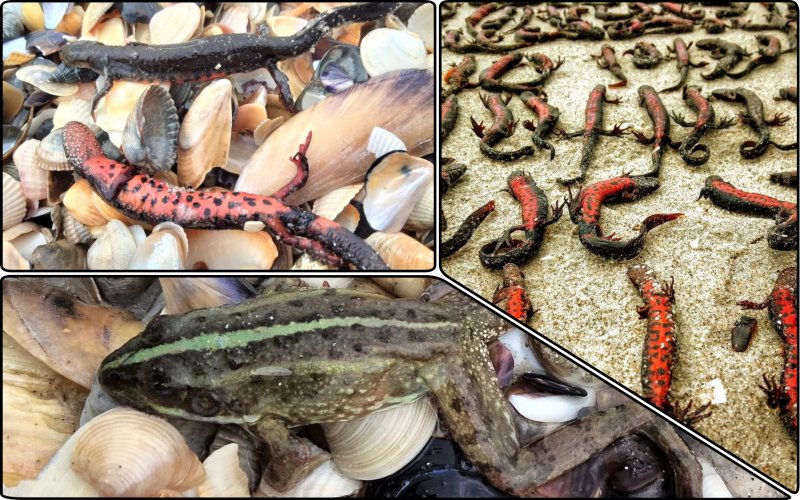
In Odesa, tens of thousands of dead newts and frogs of various species were carried away by flood flows due to the explosion of the Kakhovskaya HPP on the coast of the Tuzlivski Lymani National Nature Park.
Only 55 newts were found alive, says ecologist, biologist from the national park Ivan Rusev on Facebook.
He said that live animals immediately became food for martin birds, cormorants, herons, and terrestrial predatory mammals.
Rusev also emphasized that sea water on the coast is highly desalinated by Dnieper water.
The press service of the Ministry of Environmental Protection and Natural Resources said that the employees of the national park managed to save 55 newts.
Newts, which are listed in the Red Book of Ukraine, were carried to the coast of the Black Sea with the Dnieper waters. Our park employees found them there.
"Newts do not live in salt water. So the live animals were taken to the Danube Biosphere Reserve, where they were released in different sections of the river (tributaries). The road was successfully moved by "forced migrants". According to experts, they should adapt well in the Danube waters," the report says.
The press service added that the forces of all environmentalists are focused on liquidating the consequences of the biggest environmental disaster caused by Russia since the beginning of its full-scale invasion of Ukraine. Work on documenting and calculating the damage caused to the environment due to the Russian terrorist attack on the Kakhovskaya HPP is ongoing.
Earlier, EcoPolitic wrote, that in Odesa on the coast of the village of Hryhorivka nailed the dog which for several days was carried by the "big water" on a board from the Kherson region. Also, flood flows brought debris of furniture, equipment, plant remains and even whole houses.
As EcoPolitic previously reported, Minister of Environmental Protection and Natural Resources Ruslan Strilets said that due to the explosion of the Kakhovskaya HPP 160,000 birds were at risk of death and more than 20 thousand wild animals.