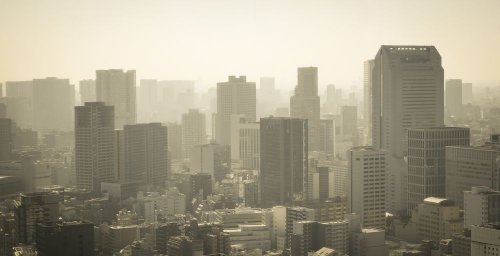
Average readings for the capital and regional centers indicate low to moderate pollution. However, there are significant local exceedances, so people in those areas are advised to limit their time outdoors.
This is evidenced by data from the international monitoring platform IQAir.
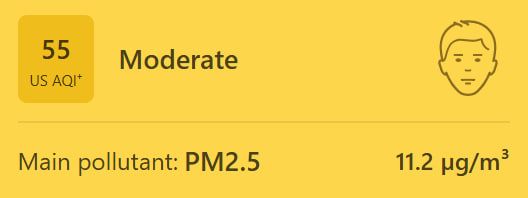
On average, Kyiv records a moderate level of pollution. The main pollutant at the moment is fine particulate matter PM2.5, with a concentration of 11.2 µg/m3. This is more than twice the upper limit of the World Health Organization standard, which is 5.5 µg/m3.
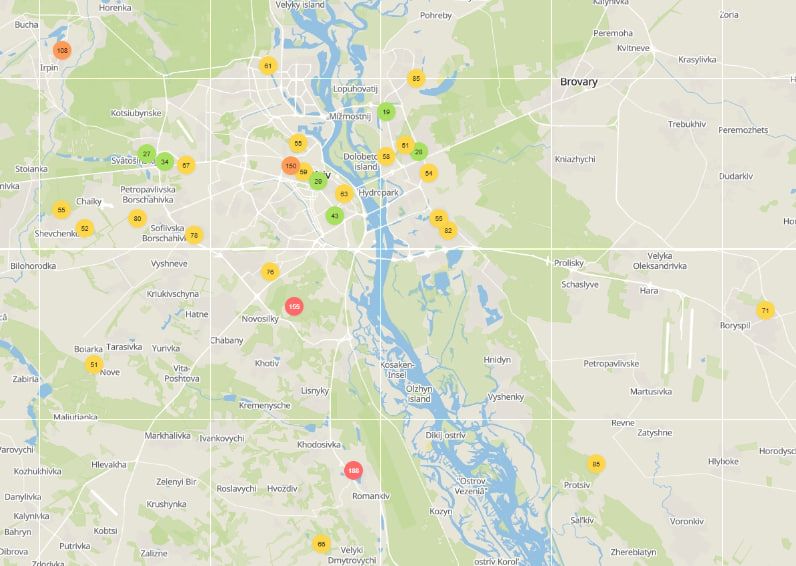
However, higher concentrations of harmful particles are recorded locally. The highest levels are near Akademika Zabolotnoho Street and on Sichovykh Striltsiv Street – 60.6 and 55.3 µg/m3, respectively. This corresponds to the "red" and "orange" hazard levels. In the first case, all residents should limit their time outdoors; in the second, people with sensitive respiratory and cardiovascular systems.
In suburban Sofiivska Borshchahivka, the pollution level is unhealthy for all residents, with a dust concentration of 118.2 µg/m3. Irpin records an "orange" level, with a warning for sensitive groups.
A number of regional centers have moderate air quality:
- Ivano-Frankivsk – 17.4 µg/m3;
- Lviv – 15.5 µg/m3;
- Chernivtsi – 14.4 µg/m3;
- Ternopil – 12.5 µg/m3;
- Odesa – 11.8 µg/m3;
- Chernihiv – 11.3 µg/m3;
- Cherkasy – 10.8 µg/m3;
- Dnipro – 10.3 µg/m3;
- Rivne – 10.2 µg/m3;
- Zaporizhzhia – 9.5 µg/m3;
- Zhytomyr – 9.5 µg/m3.
The other major cities have no critical exceedances, and the average pollution level is defined as low:
- Kharkiv – 8.4 µg/m3;
- Mykolaiv – 8.4 µg/m3;
- Lutsk – 8.3 µg/m3;
- Khmelnytskyi – 6.4 µg/m3;
- Poltava – 6.2 µg/m3;
- Uzhhorod – 4.9 µg/m3;
- Kherson – 4.2 µg/m3;
- Vinnytsia – 2.8 µg/m3.
A high content of harmful compounds in the air threatens public health. In particular, it can lead to the exacerbation or even the onset of respiratory and cardiovascular diseases. More on how the environment affects the body – in this article.