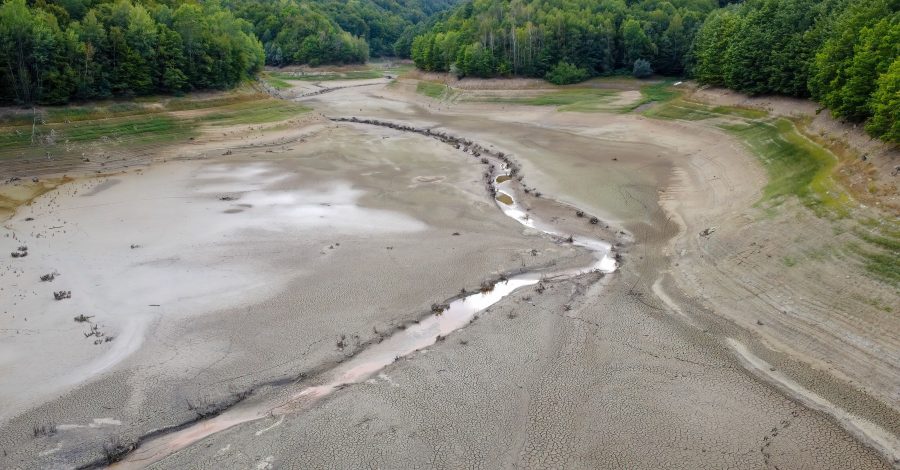
The authorities are imposing strict restrictions due to a significant drop in water levels in a number of rivers across Ukraine. The State Water Agency has set reduced water usage limits for 300 businesses, which will remain in force until 15 September. In addition to agricultural and industrial enterprises, these even include the water supply companies of a number of regional centres.
The list of restrictions is set out in the order of the State Agency for Water Resources of Ukraine.
The basis for reducing water abstraction limits is operational information on low water levels provided by the Ukrainian Hydrometeorological Centre, as well as proposals from the agency’s regional offices.
The order applies to 300 primary water users operating under special water use permits. The limits will automatically return to normal after 15 September.
Significant restrictions
The reduction in limits mainly affects the western regions of Ukraine. The list of rivers from which water abstraction has been restricted by the order includes — the Dniester, the Western Bug, the Southern Bug, the Stryi, the Uzh, the Tisa and their tributaries. However, the document also mentions entities in central and northern Ukraine.
The list consists mainly of agricultural enterprises. There are a considerable number of manufacturing and food-processing assets, including sugar refineries, dairies, a fish-processing plant and factories producing building materials.
However, the limits also apply to municipal water supply companies. For them, the limits are as follows (in cubic metres):
- Chernivtsivodokanal Municipal Enterprise — 46,681.2 instead of 51,165.3;
- Uzhhorod Municipal Water Supply and Sewerage Company — 19,239.9 instead of 21,311.1;
- Municipal Enterprise “Water Supply and Drainage” of the Svalyava Town Council — 1,653.16 instead of 2,118.77;
- The ‘Vodokanal’ municipal enterprise in the town of Korsun-Shevchenkivskyi — 1,090.7 instead of 1,854.6;
- Municipal Enterprise “VODOKANALSERVICE” of the Volovets Town Council — 272.85 instead of 338.2;
- Khodorivvodokanal Municipal Enterprise of the Khodoriv City Council — 1,574.36 instead of 1,750.92;
- The water and sewerage quota for the Slavsk Municipal Water and Sewerage Company has been reduced from 75.62 to 49.84;
- Municipal Enterprise “VODOKANAL” of the Dolyna City Council — 18,497.6 instead of 21,907.6.
Limits have also been reduced for energy companies. For example, for the Dniester Hydroelectric Power Station (617.42 instead of 3,631.9) and the municipal enterprise ‘LVIVTEPLOENERGO’ (462.39 instead of 4,203.5).
Water consumption has also been restricted for the assets of ‘Ukrnafta’ and ‘Ukrzaliznytsia’. For instance, its Lviv regional office has been authorised to withdraw 10.65 cubic metres of water instead of 66.56.
In early September, the Ukrainian Hydrometeorological Centre reported a critical drop in water levels in a number of western regions. In some places, water levels fell below historical lows.
Against this backdrop, scientists advise people to learn to save water and to adopt new solutions for rainwater harvesting at city level.
Overall, over the past 30 years, 30 per cent of rivers in Ukraine have dried up or become fragmented.
As a reminder, back in January 2026, the UN declared that the world had reached a state of total water bankruptcy.