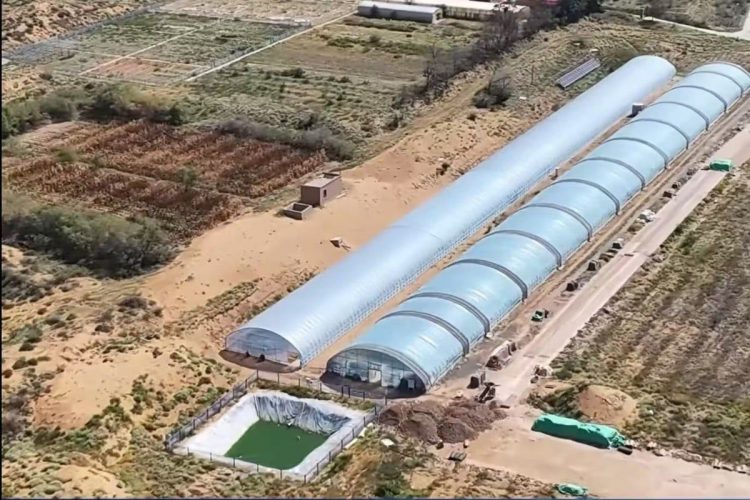
The main difficulty in combating desertification is that plants cannot take root in a moving substance such as sand. A geoengineering solution to this problem has been found in China. There, cyanobacteria (blue-green algae) are used to stabilize the surface and create a basis for plant growth.
According to the South China Morning Post, this is the first historical example of using bacteria to transform the landscape.
Artificial crust on sand
For the project, scientists selected the most resistant strains of cyanobacteria. The main factor was their ability to survive as long as possible in extreme temperatures and in the absence of water.
These bacteria, compressed together with organic matter and small solid particles into lumps, are dumped in huge quantities on the desert surface. When rare precipitation falls on the loose dunes, it is enough to awaken the microorganisms. They quickly spread their network and form a fairly strong crust on the sand. This layer is rich in biomass, thus creating the conditions for the formation of vegetation cover.
Scientists from Ningxia Province have been developing this method for 10 years. They observed how bacteria stick to the sand, forming something similar to soil clumps. Scientists have named this layer the cyanobacterial crust.
Prospects for the technology
This unique method of combating desertification was used as part of the Great Green Wall project. Plans for the next five years include expanding the area of bacterial greening to more than 6,500 hectares.
The media notes that it takes up to 10 years to stabilize sandy surfaces using more traditional methods. If cyanobacteria are used, it will take only a year to form a strong layer that can withstand winds of up to 36 km/h.
Previously, EcoPolitic reported that the large-scale greening carried out in the People’s Republic of China led to a decrease in access to drinking water across 74% of the country’s territory.
Climate change also threatens southern Ukraine, but desertification of the region can be prevented. To do so, environmentalists recommend restoring forest belts, using water bodies more carefully, introducing ecological irrigation, and implementing soil protection technologies.