On this day in 1971, the ship ‘Phyllis Cormack’, which was later renamed ‘Greenpeace’, set sail for Alaska to stop underground nuclear tests. This date subsequently became the founding day of one of the world’s most influential environmental organisations today.
EcoPolitics sets out the key facts about Greenpeace.
The first anti-radiation campaign
The organisation’s history began with an old fishing boat and a campaign against the United States’ nuclear ambitions.
As early as the late 1960s, the US began underground nuclear tests on Amchitka Island in Alaska. This sparked widespread protests, although the US went ahead and detonated the bomb anyway, and announced its intention to use one five times as powerful.
Due to the island’s seismic instability, there were legitimate concerns about possible earthquakes and tsunamis.
So, on 15 September 1971, a group of activists set off from Vancouver, Canada, for the test site. Formally, the group had been formed earlier, but this date was chosen as a symbolic one. Although they were unable to stop the explosion on that occasion, these people, united by a common cause, realised what they wanted to do in the future.
As early as 1975, the organisation spoke out in defence of whales. The large-scale campaign involved concrete actions – activists in small boats positioned themselves between the whalers and the whales. This proved successful, and in 1982 the International Whaling Commission voted to adopt a moratorium on commercial whaling.
Employment in Ukraine: then and now
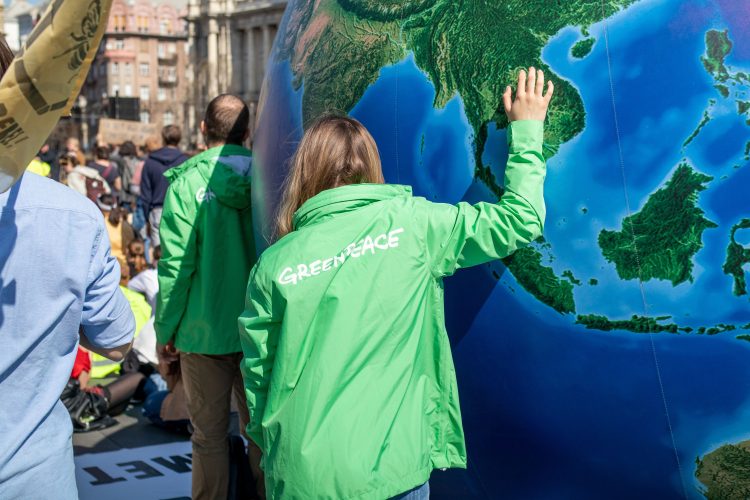
The organisation now has over 3 million supporters worldwide. Following the fall of the Berlin Wall, it gradually expanded into Eastern Europe, which had previously been under Soviet influence.
Greenpeace began its work in Ukraine following the Chernobyl disaster. It was one of the first international organisations to arrive in Ukraine. At the time, the aim was to build a modern hospital for children affected by the Chernobyl disaster.
The “Greenpeace – For the Children of Chernobyl” project was launched in 1989. The equipment was later handed over to Kyiv, and doctors from Canada shared their expertise with their Ukrainian colleagues.
At the same time, the organisation, in collaboration with other communities, has set up an independent medical laboratory. Its aim is to investigate contamination of water, soil and foodstuffs in the Chernobyl exclusion zone.
This was followed by protests against the import of toxic waste in 1993, against the expansion of the Zaporizhzhia Nuclear Power Station in 1994, and demands on Kyiv to provide the capital’s residents with high-quality drinking water.
With the outbreak of full-scale war, Greenpeace became involved in support and reconstruction efforts.
"In 2022, Greenpeace Austria, together with other regional and national organisations, launched the ‘Green Recovery for Ukraine’ project, which promotes green recovery and showcases global best practices," said the Greenpeace Ukraine branch, which was opened in September 2024.
As part of the project, two research missions were organised to Chernobyl, radiation monitoring sensors were installed near the Zaporizhzhia Nuclear Power Station, and systematic protests were held against ‘Rosatom’.