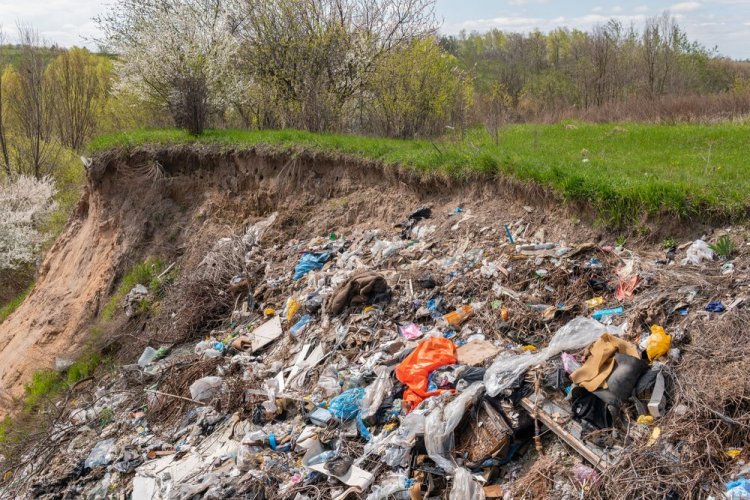
Ukraine plans to significantly increase penalties for breaches in the field of waste management. On Friday, 4 September, two government bills were registered on the Verkhovna Rada’s website — introducing amendments to the Administrative and Criminal Codes. The bills introduce new categories of environmental offences and, in many areas, impose penalties for repeat offences. Overall, the amounts of fines will in some cases increase tenfold.
EcoPolitics explains how much it will cost offenders to litter land or breach waste management regulations.
Both draft laws are classified as relating to European integration and have been submitted by the Cabinet of Ministers of Ukraine. They currently have the status ‘Submitted for information’. The lead committee responsible for these documents is the parliamentary committee on law enforcement.
Among the main aims of updating the codes, legislators point out that the penalties set out in the articles should not merely punish those responsible for offences, but should also serve as a deterrent to prevent crime. The current provisions are too lenient for this purpose.
Significantly higher fines
Amendments to the Code of Ukraine on Administrative Offences are to be introduced by Bill No. 16039. EcoPolitics lists some of them.
For damage to, contamination or littering of land and soil, members of the public will face a fine of between 100 and 300 non-taxable minimum incomes (between 1,700 and 5,100 UAH), whilst officials and business owners will face fines ranging from 300 to 1,000 minimum wages (5,100–17,000 UAH). Under the current legislation, the penalties are 20–80 and 50–100 minimum wages respectively. For repeat offences, the fines increase to 6,800–15,300 UAH for citizens and to 42,500–51,000 UAH for public officials and business entities.
In future, we will state the amounts of fines based on the current basic tax-free income threshold, which stands at 17 UAH.
Failure to take measures to control weeds will also become more costly. Currently, fines range from 340 to 1,360 UAH for members of the public and from 850 to 1,700 UAH for public officials. Once the law is passed, these amounts will rise to 1,700–5,100 UAH and 13,600–17,000 UAH respectively.
For the destruction or damage of woodland, members of the public will also have to pay 1,700–5,100 UAH, whilst public officials and business owners will face fines of 13,600–17,000 UAH. Currently, these fines stand at 510–1,530 UAH and 2,550–4,250 UAH respectively. For repeat offences within a year, the penalties rise to 6,800–15,300 UAH and 42,500–51,000 UAH.
Littering in forests currently costs members of the public a nominal 425–850 UAH, and public officials 850–1,700 UAH. The proposed bill would increase these amounts to 1,700–5,100 UAH and 13,600–17,000 UAH respectively.
Breaches of waste management requirements during the collection, transport, storage or treatment (recovery or disposal) of waste will ‘cost’ between 1,700 and 5,100 UAH for members of the public and between 13,600 and 17,000 UAH for public officials and business owners. In the event of a repeat offence, the fines will increase to between 6,800 and 15,300 UAH and between 42,500 and 51,000 UAH respectively. Currently, fines range from 340 to 1,360 UAH for members of the public and from 850 to 1,700 UAH for public officials.
The draft bill also introduces new offences, each carrying a fine:
- Failure to comply with the prescribed procedure for submitting a waste declaration, or failure to submit such a declaration — a fine of 1,700–5,100 UAH;
- Failure to take measures to remove or register unauthorised rubbish dumps — a fine of 3,400–17,000 UAH;
- Failure to have a waste management plan – a fine of 1,700–5,100 UAH;
- Carrying out waste treatment operations without the relevant permit, or failing to comply with the terms and conditions of the permit — for a first offence, the fine is 1,700–5,100 UAH for members of the public and 6,800–17,000 UAH for public officials and business owners. For a repeat offence, the fine increases to 6,800–15,300 UAH and 42,500–51,000 UAH respectively.
Other changes include:
- representatives of the civil society sector will be able to draw up reports on offences;
- executive authorities will be granted powers to close down and keep records of unauthorised rubbish dumps;
- Local state administrations will be granted the power to draw up and approve regional waste management plans.
New criminal offences against the environment and the scale of penalties
Bill No. 16040 adds a number of environmental offences to the grounds for the application of criminal law measures. In particular, these include breaches of environmental safety regulations, failure to take measures to remedy the consequences of environmental pollution, land and air pollution, and breaches of regulations on the protection of subsoil resources.
Significant damage resulting from these offences is defined as that exceeding 17,000 UAH, whilst serious damage is defined as that exceeding 34,000 UAH. Serious consequences also include mass illness among the population, a significant deterioration in the environmental situation, and the mass death of flora and fauna, amongst other things.
Other changes include:
Breaches of environmental safety regulations will result in a reduced prison sentence — from three to five years instead of the current five to ten years for a first offence. As an alternative penalty, a fine of between 17,000 and 51,000 UAH has been introduced. However, the amendments introduce a scale of offences. A repeat offence will now result in a fine of 102,000–170,000 UAH or imprisonment for a term of four to seven years. The same offence, but where it results in serious consequences or loss of life, will be punishable by imprisonment for a term of between five and ten years, with disqualification from holding certain posts or engaging in certain activities for a period of up to three years.
Failure to take measures to remedy the consequences of environmental pollution will also result in a scale of penalties:
- The penalty for a first offence is a fine of 17,000–68,000 UAH or imprisonment for a term of three to five years;
- for a repeat offence or an offence committed as part of a prior conspiracy — fines of 102,000–170,000 UAH or imprisonment for a term of between four and seven years;
- for a crime resulting in serious consequences — imprisonment for a term of between five and ten years.
Similar penalties are provided for damage to, contamination of or littering of land.
The penalties for air pollution under the new legislation will be as follows:
- 51,000–85,000 UAH for a first offence. Alternatively, imprisonment for a term of between three and five years;
- A fine of 102,000–170,000 UAH for a repeat offence or for committing the offence as part of a conspiracy. Alternatively, imprisonment for a term of between four and seven years.
- between five and ten years’ imprisonment for a crime resulting in serious consequences.
Following a similar framework, but with slightly different penalties at the stage of a first offence, penalties will be imposed for breaches of water protection regulations, marine pollution, pollution or littering of inland waters, and the unlawful import or transit of waste.
Penalties for breaches of plant protection legislation are set to rise significantly. Whilst the current fine for an offence resulting in serious consequences is up to 1,700 UAH, once the draft bill is passed, it could range from 17,000 to 85,000 UAH.
The draft bill also introduces a new offence into the Criminal Code — breach of the established waste management procedures. For a first offence, fines will range from 17,000 to 51,000 UAH or imprisonment for up to three years. For a repeat offence or one committed as part of a conspiracy, the penalty is a fine of 102,000–170,000 UAH or four to six years’ imprisonment. For an offence resulting in serious consequences, the prison sentence may be up to ten years.
EcoPolitics previously reported that fines for polluting and mismanaging water bodies could also rise significantly in Ukraine.
And in this article, you can find out how much fish you’re allowed to catch for free.