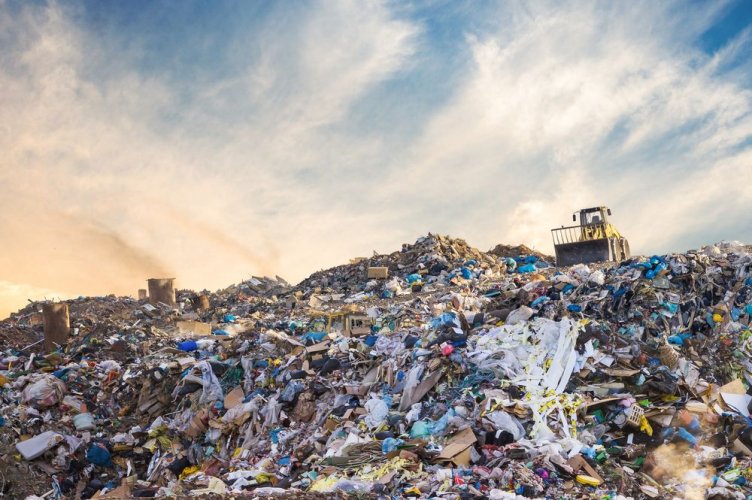
Humanity has almost reached the level of waste generation previously projected for 2030. Waste is piling up, and the waste management sector requires ever-increasing funding. Global municipal spending on waste management already exceeds $250 billion annually and is projected to rise to $426 billion by 2050.
This is according to the World Bank’s solid waste report, What a Waste 3.0—the third and updated edition, which forecasts the situation through 2050.
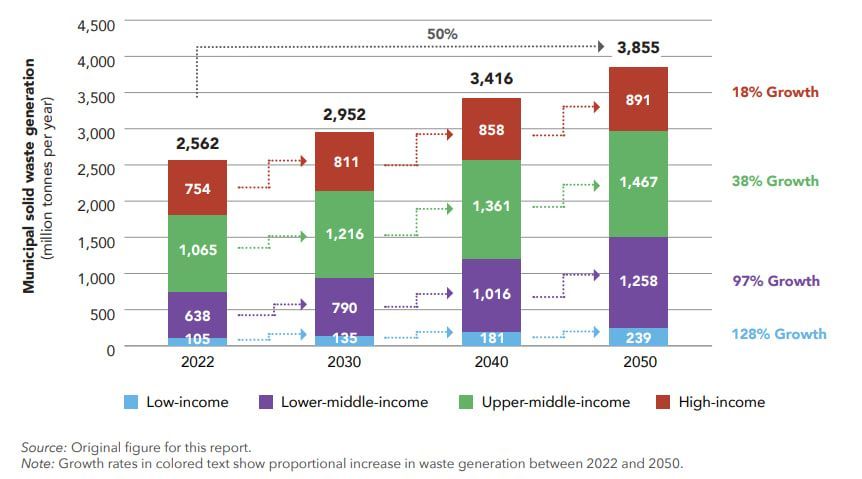
In 2018, analysts published data indicating that by 2030, humanity would generate 2.59 billion tons of household waste annually. However, according to the latest data, this figure reached 2.56 billion tons as early as 2022. By 2050, this number will increase by nearly 50%—to a staggering 3.86 billion tons per year.
Source: worldbank.org
Which regions generate the most waste?
The report identified a direct correlation between a country’s level of prosperity and the amount of waste its population generates. For example, in countries with a high income level, which are home to 16% of the world’s population, 29% of global waste was generated in 2022. In the world’s poorest countries, 9% of the population accounts for just 4% of waste.
On a regional scale, East Asian countries account for the largest share of waste at 33%, while the smallest share goes to the Middle East and North Africa at 6%.
Household waste composition
In low-income countries, about 52% of all municipal waste is made up of organics and food waste. By contrast, in wealthy countries, around 50% of the waste consists of dry materials suitable for recycling, textiles, and electronic and electrical equipment waste.
Plastic accounts for an average of 12.5% in the structure of global waste. Here, the financial factor plays a role: in poorer countries, the figure is 8.1%, while in wealthier ones, it reaches 13.1%. Notably, 65% of this type of waste is single-use plastic.
Nevertheless, food waste makes up the largest share globally-38% of all municipal waste. Organic waste is relatively easy to process into fertilizers, yet only 6% of this waste type is composted worldwide, and in poor countries, just 1%.
Global waste management practices
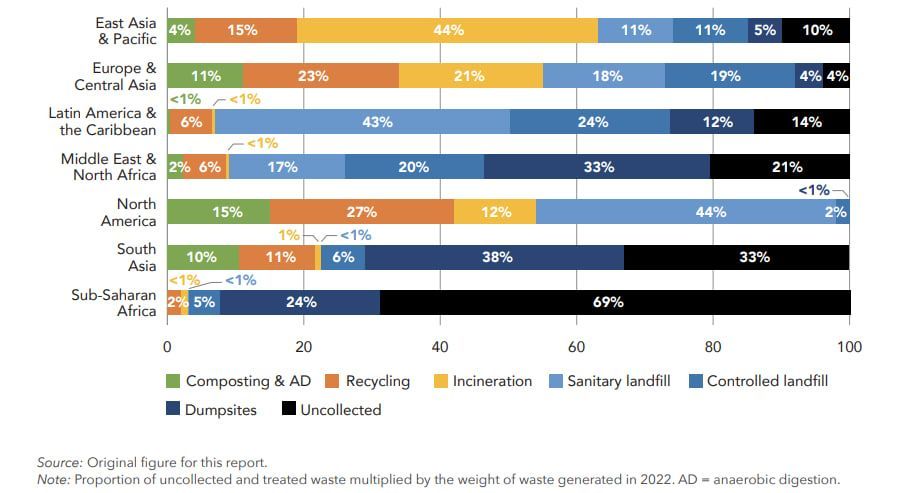
The World Bank report shows that in high-income countries, the waste collection rate is close to 100%. The situation is worst in low-income countries, especially in Sub-Saharan Africa, where only 31% of waste is centrally collected.
A similar trend is observed with processing. In wealthy countries, nearly 100% of municipal solid waste is processed at controlled facilities, while the rate is extremely low in poorer countries-only 3%. Most waste is either discarded at dumpsites or not collected at all.
The most “popular” waste management methods are:
- 29% – landfilling;
- 21% – recycling, composting, and anaerobic digestion;
- 20% – incineration with energy recovery;
- 30% – dumped in open areas or not collected at all.
Source: worldbank.org
The threat of plastic
The management of this segment of waste is extremely inadequate. About 13% is hardly processed at all and is simply dumped in landfills. Globally, 16% of plastic waste is not collected at all. Combined, this amounts to over 93 million t of plastic per year that is neither sorted nor recycled.
Approximately 87% of uncontrolled plastic waste is generated by middle-income countries.
EcoPolitic previously reported that in the European Union, only 48% of half a tonne of waste generated per capita is recycled.