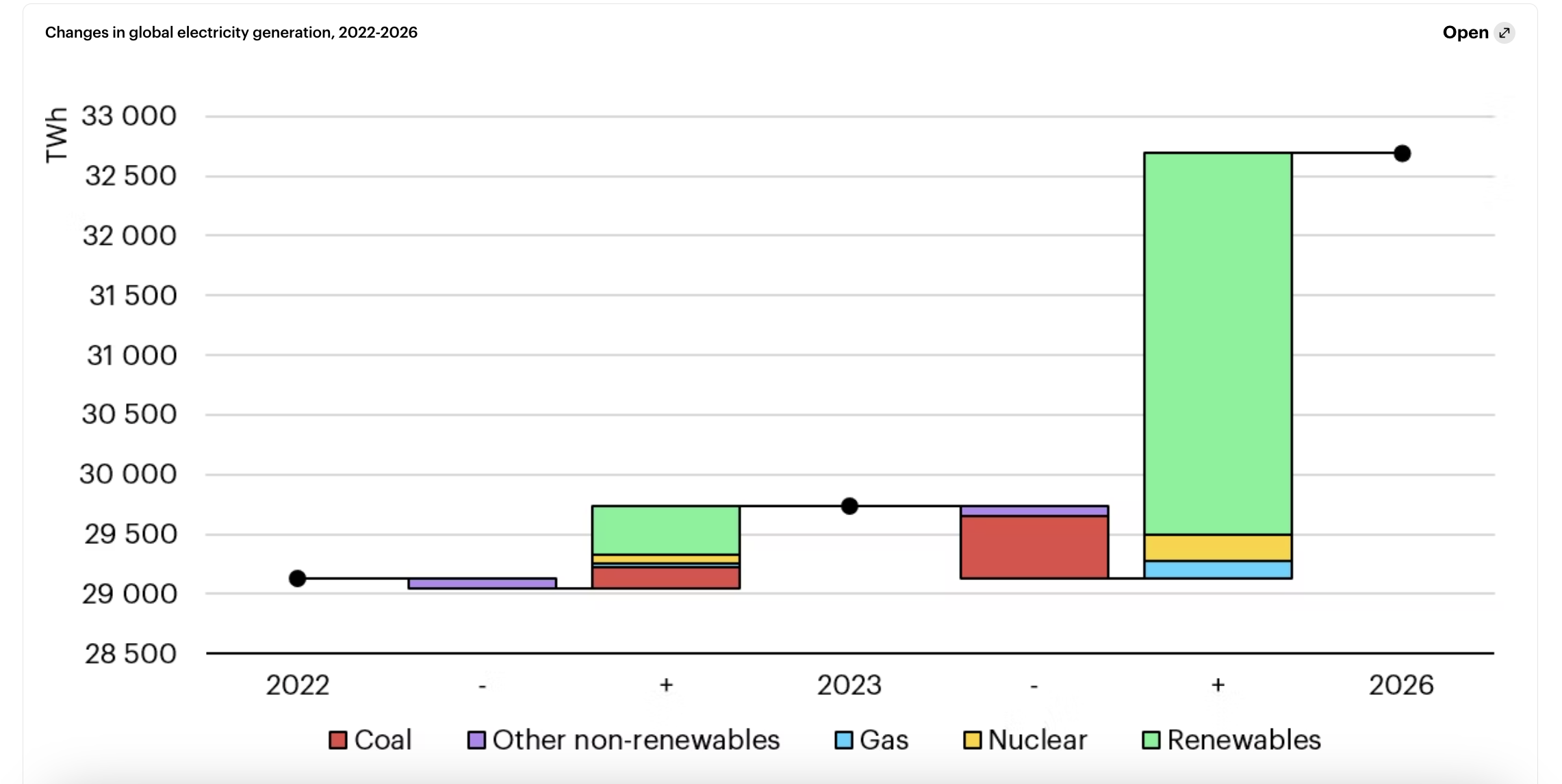
According to the International Energy Agency, record production of electricity from low-emission sources, including nuclear and renewable energy, should cover all the growth in global electricity demand by 2026.
They are expected to account for almost half of global electricity production by 2026, up from 39% in 2023, according to the IEA's Electricity 2024 report.
It is noted that the growth in the share of these energy sources will offset the growth in demand in the US, the EU, and potentially in China. The growth will largely be due to the scaling of solar capacity, which is becoming cheaper.
iea.org
The IEA emphasized that a significant expansion of renewable electricity capacity should also be accompanied by accelerated investments in networks and system flexibility.
"By the beginning of 2025, RES will provide more than a third of the total electricity production in the world, overtaking coal," the report says.
Rapid growth in renewables, supported by rising nuclear generation, is set to displace global coal-fired generation, which is forecast to decline by an average of 1.7% annually through 2026, it said. Electricity generation from natural gas is expected to grow by about 1% each year through 2026.
The share of fossil fuels in global generation is projected to decline from 61% in 2023 to 54% in 2026, falling below 60% for the first time since 1971.
The IEA recorded that the growth in electricity demand in 2023 slowed down to 2.2%, compared to growth of 2.4% in 2022. According to forecasts until 2026 global demand for electricity will grow by 3.4% per year. About 85% of additional demand for electricity by 2026 will come from outside developed economies, particularly China.
The report added that global carbon emissions from electricity generation will fall by more than 2% in 2024 after increasing by 1% in 2023. A slight decrease in these indicators is also expected in 2025 and 2026.
Earlier, EcoPoliric wrote, that according to the International Energy Agency (IEA), in 2023, global RES capacity increased by 50% from the level of 2022, i.e. to 510 GW.
As EcoPolitics previously reported, the energy transition scenario envisages a doubling of global electricity production to 46,000 TWh by 2050, and the Net Zero strategy to more than 80,000 TWh, which is three times the current amount.