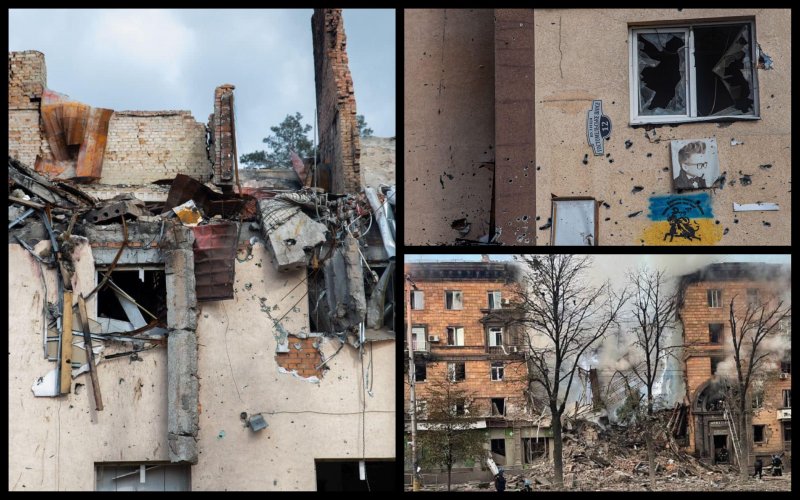
In Ukraine, due to Russia's military aggression, the amount of destruction waste per year, according to preliminary estimates, reached 10-12 million tons, which can be compared with the amount of annual solid household waste.
The situation with demolition waste in Kyiv, Zhytomyr, Sumy and Chernihiv regions was discussed at a conference call with the heads of regional military administrations, the Minister of Environmental Protection and Natural Resources Ruslan Strilets reported on Facebook.
He emphasized that the meeting was held under the chairmanship of the Prime Minister of Ukraine Denys Shmyhal.
"Cleaning of territories from waste of war continues in other de-occupied territories as well. In order for this process to be as effective as possible, the Cabinet of Ministers established a clear algorithm of what and how to do with demolition waste. So now it is important that the regions properly organize this work, following the example of the Kyiv region," said Strilets.
It is noted that Kyiv region was the first region to arrange 62 sites for temporary placement of demolition waste. Currently, there are 144,000 tons of war waste at 48 sites.
The shooter said that communities take demolition waste to temporary storage sites, where they are sorted, that is, dangerous, construction and other waste are separated. Construction waste is crushed for reuse, in particular for the post-war reconstruction of Ukraine.
"The high-quality organization of works in the Kyiv region contributed to the involvement of international partners who are ready to help with modern technologies, equipment, and the implementation of specific solutions," he emphasized.
Strilets noted that the Ministry of Environment is constantly negotiating with international partners to provide Ukraine with the necessary assistance - mobile crushers for construction waste, equipment for actual analysis and sorting, etc.
"Our goal is that the waste of the destruction does not go to the landfill, but is rationally used during the reconstruction of our country. And it will certainly be large-scale," he said.
Earlier, EcoPolitic wrote, that on September 27, the Cabinet of Ministers approved the "Procedure for handling waste from the destruction of buildings and structures" resulting from damage caused by hostilities, acts of terrorism, sabotage or liquidation of their consequences.
As EcoPolitic previously reported, Deputy Minister of Environmental Protection and Natural Resources Yevgeny Fedorenko at the Climate Summit COP27 emphasized that in Ukraine, the waste of war has already acquired such a scale, which has not existed on the European continent since the Second World War.